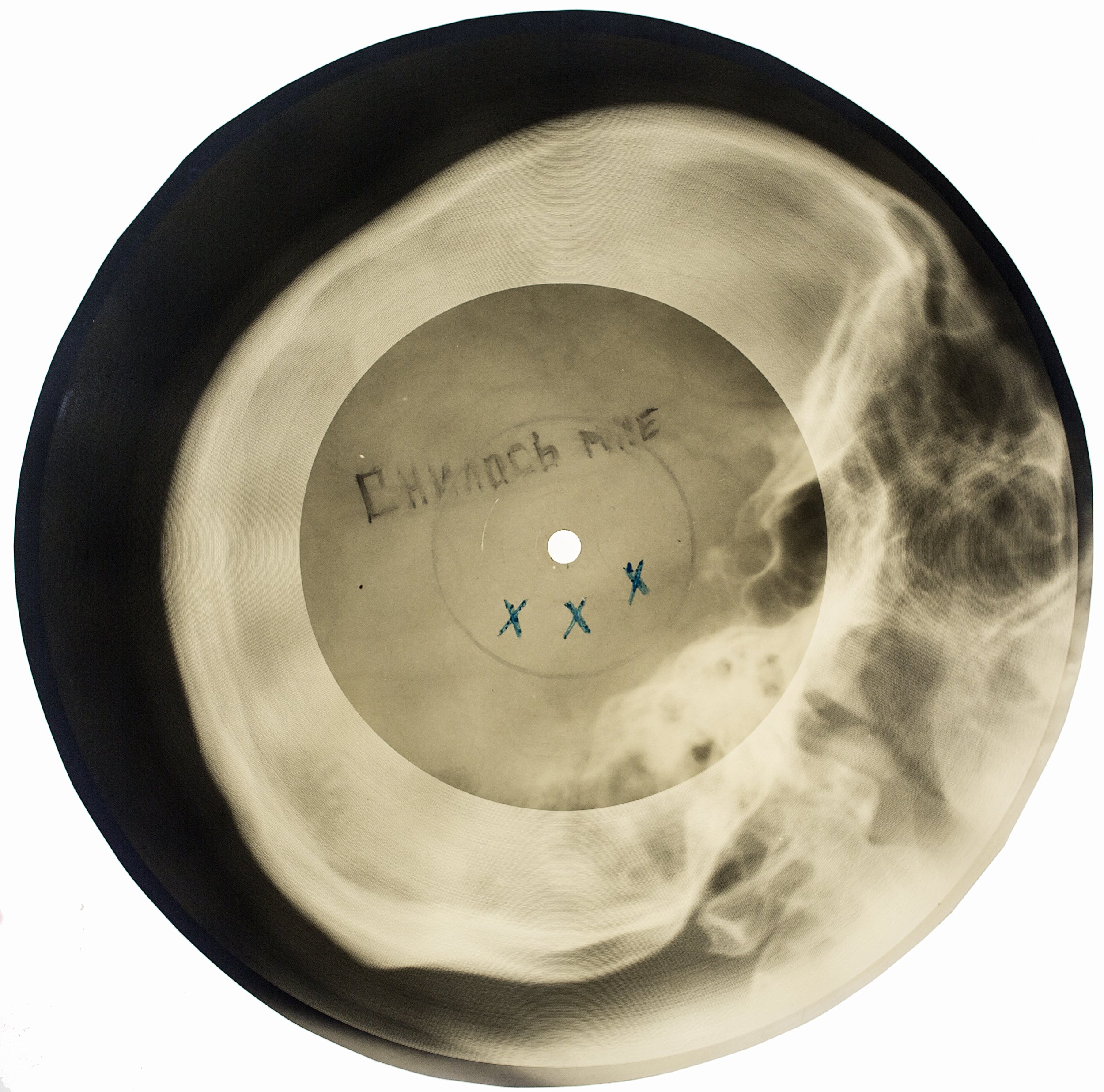
In the darkness of the Soviet totalitarian state, where the human voice itself was tightly regulated by the Ministry of Culture, a musical and linguistic underworld thrived in the shadows. This underworld spoke - and sang - a language entirely its own: a language which was to appear regularly on bone records

Fenya, also known as blatnaya mova or "thieves' cant”, was a cryptic slang, originally used by medieval Russian peddlers to hide their dealings from outsiders. It evolved over centuries into the dialect of the 'vory v zakone’—a brotherhood of thieves that dominated life in Tsarist prisons and, later, the vast network of the Soviet Gulag. It was a language of survival, designed to build solidarity among prisoners while keeping guards and state informants in the dark
Fenya didn't remain confined behind barbed wire or among traders. It leaked into the broader culture through song, specifically through the genre known as blatnaya pesnya (thieves' songs) - more lately called ‘Russian Chanson’. These songs were usually acoustic, often just with a single guitar, accordion or a small ensemble, with lyrics describing betrayal, criminal romance, the harshness of Siberian exile and even just the realities of Soviet life. During the decades when the state actively banned this music, criminal songs became a powerful form of countercultural resistance. Because the official Soviet press only allowed upbeat, optimistic anthems about industrial progress and socialist triumph, these underworld ballads offered a raw, deeply human alternative. They spoke of real suffering, systemic cruelty, and a dark romance that connected with millions of citizens who had no connection to the criminal world but felt trapped by the rigidity of Soviet life.
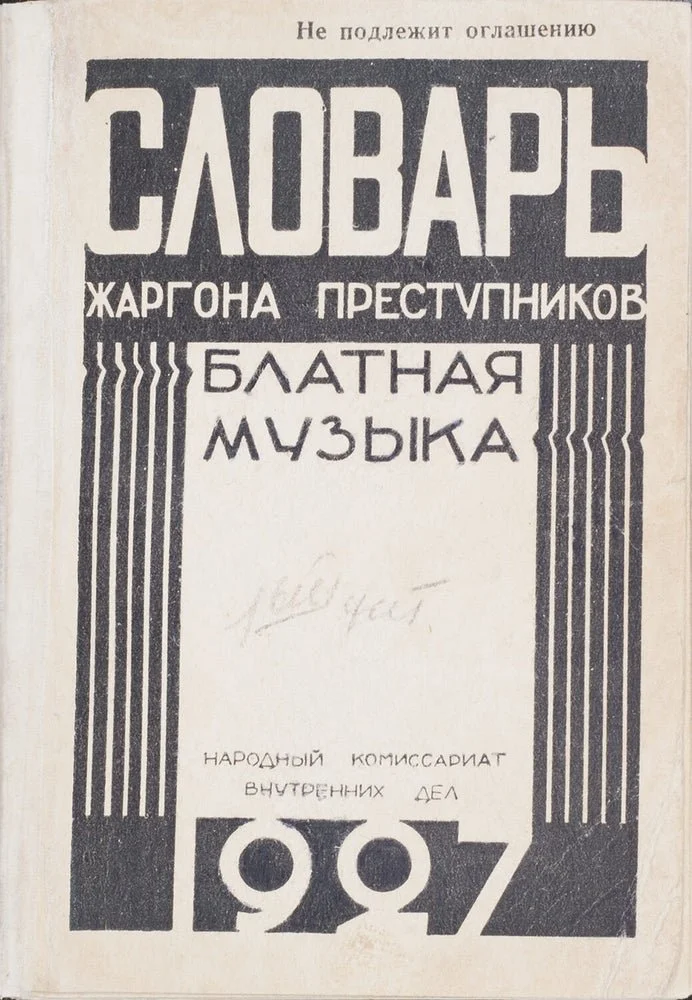
‘Speak like the Criminals’ To prevent illegal actions, criminal slang was decrypted in this dictionary for police, prison guards and court officials.
The power of the lyrics depended entirely on Fenya. The slang was used partly for secrecy, but also to establish street cred.. In these songs, a criminal was not simply a thief; he - or she - was a blatnoy, an honourable member of the underworld who refused to cooperate with the authorities. Money was referred to as babki or kapusta, a gun was a shpaler, and a knife was a pero, literally a feather. Informants and traitors were branded as suki (bitches) or stuchachi (knockers, those who knock on the guard’s door to snitch). To speak or sing this language properly was known as botat po fenye, - "talking the cant”. By weaving these terms into traditional folk melodies and Russian tangos, underground musicians created a subversive folklore.
Because the state forbade the performance or official recording of blatnaya pesnya, the music had to find alternative spaces to be heard. It was performed in the communal apartments known as kommunalki, where neighbours gathered behind closed doors, singing quietly to avoid the ears of informants; in drinking dens, at informal backyard gatherings, in wartime trenches and in hidden underground venues across cities like Odessa, Moscow, and Leningrad. Most significantly, it was performed in the Gulags.
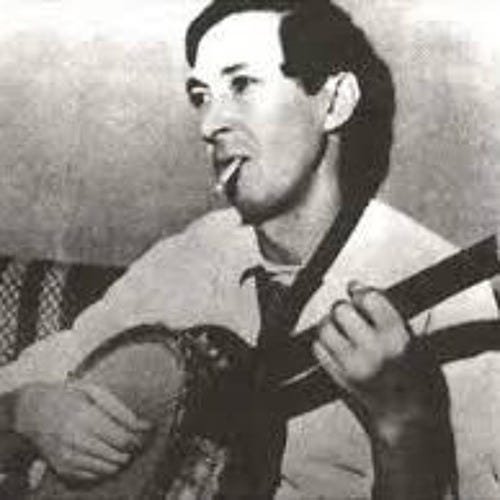
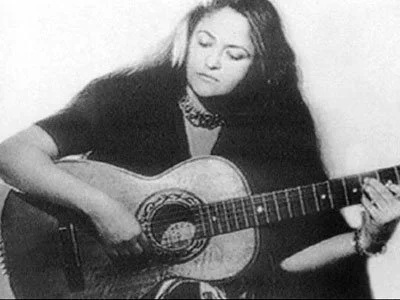
Underground singer Arkady Severny
Under Stalin, the Gulag system expanded on an unprecedented scale, bringing millions of people into contact with the criminal underworld. In the camps, where political prisoners and hardened criminals mixed, Fenya evolved from a thieves’ argot into a broader prison language, crossed into the vocabulary of the Soviet intelligentsia, acquiring new words and meanings shaped by camp life. For many inmates, it became a tool of survival, allowing them to navigate a complex social world governed as much by criminal custom as by Soviet authority.
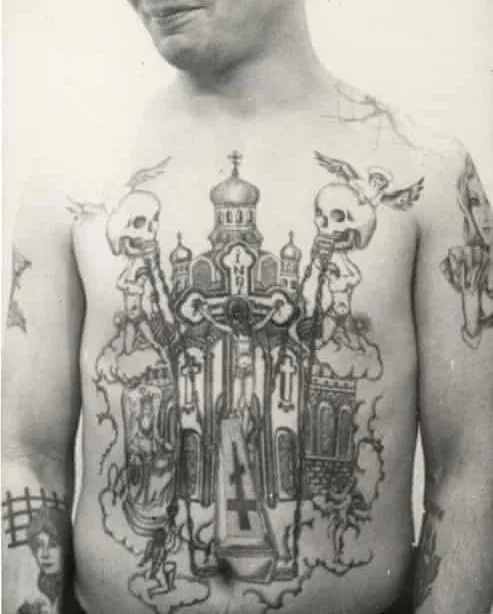
Professional criminals, known as vory occupied the top of a rigid hierarchy regulated by the vorovskoy zakon—the thieves’ code. This unwritten set of laws dictated behaviour, loyalty and status, separating career criminals from ordinary prisoners, or muzhiks. Elaborate tattoos functioned as a visual language, recording a prisoner’s rank, convictions, allegiances and personal history. Together, Fenya, tattoos and the thieves’ code formed a parallel culture within the camps, one that often proved more powerful in daily life than official Soviet rules.
Stalin sought to eradicate criminal culture, but inadvertently helped spread it. The authorities condemned thieves’ slang and songs as corrupting influences and sought to suppress them, but they continued to be used and heard in prisons, taverns and private gatherings. Following Stalin’s death in 1953, a mass amnesty released more than a million prisoners. They carried Fenya, prison folklore and the songs of the camps back into Soviet society, where blatnaya pesnya—the thieves’ song tradition—found an eager audience. Attempts to silence it only added to its appeal, helping transform an underground prison culture into a lasting part of Russian popular culture.

In the post-war era, with state-run labels holding a total monopoly on vinyl production, underground entrepreneurs cutting bootleg records on X-ray film became the primary vehicle for distributing banned music. Buying a criminal song on an X-ray disc was a double act of defiance. The physical object itself exposed the hidden injuries of the Soviet populace, while the groove etched into the surface carried the outlawed voices of the blatnoy singing in Fenya. Through this intersection of criminal argot, urban lore, and DIY technology, Fenya and blatnaya pesnya, the thieves’ songs, managed to bypass the censors entirely, leaving an indelible mark on the cultural history of the Soviet underground.
Here are some famous songs from the genre:
Taganka (Таганка)
Named after an infamous transit prison in Moscow, Taganka is the ultimate jailhouse lament. The lyrics are a direct address from the singer to the prison itself, which "has destroyed his youth." It captures the deep fatalism of the Soviet criminal underworld. Its mournful tango rhythm made it a staple of underground acoustic performances, later popularised by underground icons like Vladimir Vysotsky and Arkady Severny.
Gop-so-smykom (Гоп-со-смыком)
This song is a character portrait of an unrepentant, high-society thief. In Fenya, Gop refers to a street robbery or mugging, while a smyk means a violin bow -slang for a master key. The protagonist is a criminal who can pick pockets, break into safes, and play the violin to charm his victims. It is a bouncy, theatrical number packed with Fenya describing the mechanics of a heist.
S Odesskogo Kichmana (С одесского кичмана)
In Fenya, kichman means a prison or penal colony. This song tells the dramatic story of two seasoned thieves escaping an Odessa jail. One of them is mortally wounded and begs his comrade to bury him out in the open steppe rather than letting the authorities take his body. In the 1920s and 30s, the famous jazz singer Leonid Utyosov famously performed this for Soviet elites—including Stalin, who had been imprisoned as a criminal himself, allegedly—in private, even though the state officially forbade it.
Bublichki (Бублички)
Written in Odessa during the NEP (New Economic Policy) era of the 1920s, this song is written from the perspective of a young girl selling hot bagels (bublichki) on the freezing streets to survive. While not strictly a song about thieves, it perfectly captured the desperate, gritty urban underbelly of the era. Its haunting Jewish klezmer-infused melody made it incredibly popular on early bootleg recordings.
The night is coming, the lanterns swinging
A cop is cursing in the darkness of the night.
I'm filthy and wrapped in rags
And broken, barely walking.
Buy my bagels, my hot bagels,
Give me your rubles right now
And on this rainy night pity me
A miserable private trader.
Tsyplenok Zhareny (Цыпленок жареный)
Literally translating to "The Roasted Chicken," this deceptively upbeat, nursery-rhyme-like song dates back to the Russian Civil War. It uses the metaphor of a little chicken walking down the street who gets arrested by the secret police because "he didn't have a passport." It was widely understood as a sharp, satirical commentary on the arbitrary brutality of state authorities and the constant threat of arrest facing ordinary citizens and criminals alike.
Na Kolyme (На Колыме)
Kolyma was the most notorious geographic region of the Soviet Gulag system, located in the extreme Russian Far East and synonymous with gold mining and lethal working conditions. This song is a bleak, slow ballad about a prisoner who knows he will never return home to his mother, cursing the day he was sent to the "cursed planet" of Kolyma. It represents the darker, more tragic side of the genre, focusing on the sheer weight of state oppression.
Murka (Мурка)
Perhaps the most famous song of this culture is Murka. Written in the 1920s and set in the gritty criminal underworld of Odessa during the chaotic aftermath of the Russian Revolution, the song tells the story of an underworld gang whose leader falls for a fierce, beautiful woman named Marusia (nicknamed "Murka"). The plot takes a dark turn when the gang discovers Murka is actually an undercover agent for the Cheka (the Soviet secret police) sent to sting them.The song is saturated with Fenya, describing a world of clandestine meetings, stolen luxury goods, and ultimately, a bloody retribution. When the narrator discovers Murka’s betrayal, he confronts her in a smoke-filled tavern where the narrator confronts her, singing lines packed with heavy Fenya before executing her for her betrayal.
"Zdravstvuy, moya Murka, zdravstvuy, dorogaya... Ty menya zdala."
"Hello, my Murka, hello, my dear... You sold me out."
Murka became a kind of anthem of the Soviet counterculture, a cultural phenomenon. It was so deeply forbidden by the Soviet authorities that merely singing it in public could get you detained for "anti-Soviet agitation," yet virtually every citizen—from Gulag inmates to high-ranking state officials—knew the words. It was one of the most common tracks pressed onto X-ray discs, its dark, tragic tango groove perfectly matching the ghostly ribs and skulls of bone records.
The collapse of the Soviet Union and the rise of Russian Chanson as a mainstream musical genre helped popularise many criminal expressions. Words that were once recognisable only to criminals entered mainstream speech. Terms such as blat (connections), fraer (a sucker or outsider), musor (cop), razborka (showdown or settling of scores) and bespredel (lawlessness) are now widely understood by ordinary Russians.
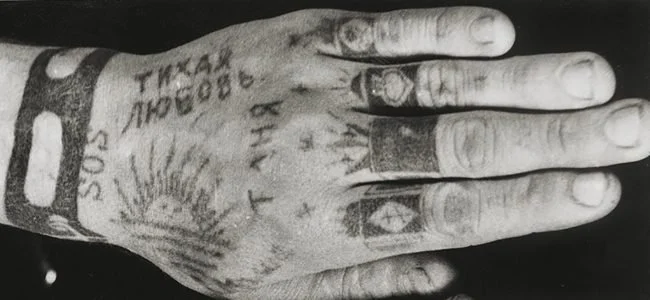
Criminal tattoo
———
The world expert on underground Russian song, Blatnaya pesana and Russian song is Maxim Kravchinsky, Read his potted history of the subject HERE
———
There is a linked Russian lingo called Mat (мат) which is not a secret language like Fenya. Rather, it is a traditional Russian system of profanity and obscenity—a highly developed repertoire of swear words and expressions built around a small number of root words.
Historically, Mat was associated with peasants, soldiers, labourers and other predominantly male environments. The Soviet state officially prohibited it in print, broadcasting and public life, yet it remained ubiquitous in factories, barracks, construction sites, prisons and the military. Like Fenya, it flourished despite official disapproval.
Fenya and Mat became closely intertwined in the Gulag. Prisoners mixed criminal slang and obscenity together, creating a camp vernacular. A prisoner’s speech could immediately reveal his social status, criminal experience and relationship to the thieves’ world. Both appear in blended form in songs and on Bone records.
Mat remains common in everyday spoken Russian despite periodic attempts by governments to restrict its public use. Films, books, theatre productions and broadcasters can still face penalties for its use but most Russians encounter it daily in conversation.